


last weekend, i went to the bata shoe museum in toronto, canada. now at first thought, even i will admit that an entire museum dedicated to shoes can seem to be a frivolous use of space. i say “even i” because i love museums and, well, a good pair of shoes. or 12.
but it really depends on the way the museum curates and presents the objects of interest, whatever those may be. i didn’t know whether it would be more “fluff” or if they would dig deeply and present what could be a fascinating story of the shoe.
when i entered, the first exhibit was on canadian fashion media reporter, jeanne beker. my heart sank just a little. nothing against jeanne…i watched her on FT before it was even called that. and to this day i immediately envision models strutting half-naked on the catwalk whenever i hear the theme song, obsession. but — i don’t really care much about what running shoes she wore a couple of years ago. i really hoped that this sort of thing wouldn’t be the focus of the exhibits throughout the place.

{ yawners }
though on my way out of that exhibit, i did learn a bit of interesting info that made me wish i didn’t judge so quickly. jeanne beker studied pantomime… in the 1970s… in paris? really?

{ yes really! jeanne beker’s pantomime shoes and a photo of her in background. }
i didn’t know that. actually, that makes a lot of sense now that i think about her physical features. i can totally see her doing it. actually, i’d love to see her mime an imaginary box around karl lagerfeld. (i think that last sentence may have insulted mimes and the entire haute couture industry, but really, if they’re listening, pantomimed interviews just might be the next big trend.)
after the jeanne beker exhibit, i went into the main exhibit area. hello! here it was, the stuff i was hoping for. the nitty gritty, detailed history of the shoe and how it has evolved through the years. it was as fascinating as i’d imagined.
the exhibit began with one of the most significant findings regarding human evolution: upright walking.

{ um, ana? you’re taking the whole “start at the beginning” thing rather literally, no? }
i can’t hear you! in 1976, archeologist mary leakey discovered the footprints of bipedal hominids. these footprints (photo above) were made over 3.7 million years ago, and as we know, our ability to walk upright has significantly influenced us as a life form.

{ ancient egyptian shoes. }
the exhibit explained how the shoe evolved over time, and how it went from a functional piece of clothing to a status symbol very early on.

{ a pair of paduka shoes from india, 18th century. the detailed engraving and gold toe nobs indicate that these shoes likely belonged to an upper class woman. i can’t imagine balancing and holding these shoes between my toes! }
then there were these. aww, cute wittle baby shoes?

guess again. these shoes, measuring about 7.5 cm (3″) were for adult women whose feet had been bound to achieve the “ideal” san zun measurement. ouch!
the exhibit followed the path of the shoe through various religions, and explained how social and political climate influenced the design and structure of the shoe.
there were four floors of exhibits, and one of my favourite ones dealt with role of the shoemaker, the craft behind his or her work (moccasins made by indigenous people were primarily made by women, it was their craft and the designs sewn or painted onto them reflected their own family history and personal creative talents), and their place within history and social hierarchies …

{ the humble shoemaker, with shabby clothing and bottle of wine at his feet, is seen with his caged bird. not allowed to speak openly about politics, this 19th century depiction of a shoemaker shows him singing innocently about it to his bird instead. }

{ detailed hand-stitching on a pair of leather moccasins, circa 1800s. }
another favourite exhibit was a temporary display about the roaring 20’s. this described how political and social changes for women after the suffragette movement influenced shoe design.

with all the newfound freedoms of expression, the hemlines and haircuts got shorter, and for the first time, women’s shoes got a t-strap…to keep the shoe firmly on the foot with all that go-getting and footloose dancing.

the stock market crash and subsequent depression influenced shoe design as well. the shoe itself didn’t change much from the twenties, but shoes were primarily gold or silver-toned (or both). at first, this bit of bling originated in the escapism presented through hollywood at the time. it might seem like an unlikely extravagance during such a difficult economic time, however, the marketing behind these metallic toned shoes was that “gold and silver go with everything!” so one pair of these shoes could potentially be worn with every outfit. if you could afford dressy shoes in the first place, that is. work boots and loafers were more commonplace.
there is so much more that the bata shoe museum offers that i could get into, i spent a solid afternoon there. but i think i will stop here and just say that if you happen to be in toronto, and have any interest in shoes (from a fashion, craft, artistic, historical or just-plain-curious perspective), i think you’d really enjoy a visit.
as for me? i originally wanted to go this museum when it first opened. somehow, i blinked and 16 years flew by. don’t leave it that long.
before i go, just for fun…what do you think these ominous looking shoes were made for? leave me your guesses. the correct responder gets to walk around with a smug grin.
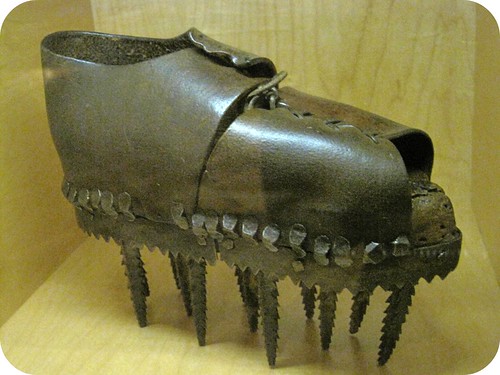
{ mystery shoe. the answer, next time… }



Walking on ice, like glacier ice? I would have enjoyed this museum very much.
i thought of you and your beans while i was there. there was a whole display about the anasazi indians and how they crafted their shoes.
How neat! You know, I swear I read a blog post not that long ago from someone else who visited this museum… just wish I could remember who wrote it!
Love your pictures and descriptions… tidy those Egyptian sandals up a bit, and I’d wear them out on a sunny Saturday! :) I really like seeing all the shoes from different cultures – I knew about Chinese foot-binding, but those Indian shoes are really something… they almost look like those Japanese sandals on platforms.
As for the last pair… since stomping around on a particularly nasty ex-boyfriend is probably not the correct answer, I’ll go with lawn-aerating. :)
thanks victoria, and oh! if you remember the other blog post, let me know. i’d love to read another perspective.
I loved this place and think I have some of the same pictures. You made me feel like I was there again.
Thanks!
cool :)
I read this post in a coffee shop in Bangalore (South India). Walked a mile home to my friend’s house, with a new appreciation for my sandals. Then suddenly, while crossing a crazy busy street, I remembered this:
and laughed out loud. So loud and with such a silly grin on my face that the guy about to run me down came to a screeching halt and grinned right back at me.
Really, really enjoyed this. Thanks, ana!
Wait, that didn’t come out right at all! Trying to be clever with html never gets me anywhere.
Here’s how it was supposed to go:
I read this post in a coffee shop in Bangalore (South India). Walked a mile home to my friend’s house, with a new appreciation for my sandals. Then suddenly, while crossing a crazy busy street, I remembered this:
{um, ana? you’re taking the whole “start at the beginning” thing rather literally, no? }
i can’t hear you!
and laughed out loud. So loud and with such a silly grin on my face that the guy about to run me down came to a screeching halt and grinned right back at me.
Really, really enjoyed this. Thanks, ana!
funny! (and html gets me every time < /i> )
I’m going to guess something to do with mountain/glacier climbing as well. I wish I had checked out the museum while I was living in TO. Who knows when I’ll get back there with a whole afternoon to myself. Thanks for the mini tour.
you’re welcome marti, i wish i’d gone sooner but was glad to finally visit.
Thanks for the nice introduction to the museum. More interesting than I would have imagined! I’ll guess the monster shoes are for aerating your lawn.
you’re welcome! and yeah, i had a few people give me that polite smile when i told them i went to a shoe museum :P
Is it made out of metal? That wouldn’t work well with ice, nor with say, lava. I’m still thinking. lol
sorry about the photo, behind glass and bright lights reflecting off the glass. the spikes were made of metal. i think the top was leather.
ummm were those shoes used for torture?
well, they were a nut-cracker of sorts…
Pingback: mystery shoe revealed | i made it so.
I would love to go to a museum like this. This all so very interesting. Thank you for sharing.